
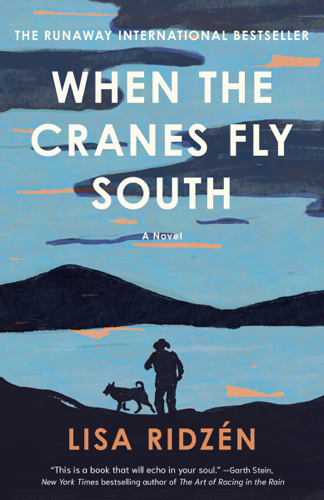
A Story That Doesn’t Shout — It Whispers
Some stories don’t need to be loud to move you.
They come quietly, like the sound of wings in the distance.
Lisa Ridzén’s When the Cranes Fly South, translated by Alice Menzies, is one of those rare novels that speak straight to the soul — soft, slow, and impossibly human.
It’s a story about getting old. About refusing to surrender.
About love that doesn’t fade, even when memory and strength begin to slip away.
Meet Bo — The Man Who Refuses to Give Up His Freedom
Bo lives alone in a small cabin in northern Sweden. He’s old now — his back hurts, his balance falters, and winter comes sooner than it used to. But what he still has is freedom, and he’s not about to let anyone take it from him.
His only constant companion is Sixten, his loyal dog. Together, they face each day like it might be their last — chopping wood, feeding the fire, watching the cranes fly above the frozen fields.
Bo’s son, Hans, lives far away and wants his father to move into a nursing home. It’s the logical choice. The safe choice.
But Bo has lived too long to let others decide what’s best for him. For him, leaving home means losing the last piece of himself.
That’s the quiet conflict at the heart of this story — not between good and evil, but between love and control, freedom and fear.
A Novel About Aging, But Also About Living
Lisa Ridzén captures something few novels about old age manage to express — the fierce vitality that remains even when the body weakens.
Bo doesn’t see himself as a victim of time. He’s not ready to “retire from being alive.”
He still wants to choose, to walk, to breathe, to matter.
Every small act — carrying logs, petting Sixten, lighting a fire — becomes an act of resistance, a way of saying I’m still here.
And Ridzén’s prose, beautifully translated by Alice Menzies, gives those small acts a sacred kind of weight. Her writing is sparse but luminous, like sunlight on snow.
Sixten, the Dog Who Holds It All Together
If you’ve ever had a pet who understood you better than any human could, you’ll love Sixten.
He’s not just a dog — he’s Bo’s shadow, his anchor, his last link to unconditional love.
Sixten doesn’t speak, of course, but his presence says everything. When people fail to understand Bo, Sixten does. When the world grows too quiet, Sixten fills it with life.
Their relationship is one of the most touching depictions of human-animal companionship in modern fiction.
It’s no wonder so many readers call this “the most beautiful book about aging and love since A Man Called Ove.”
The Cranes — A Symbol of Time and Return
The cranes that migrate south each autumn give the novel its name — and its soul.
For Bo, they are more than birds. They are a reminder that leaving isn’t always loss. The cranes go, but they also come back.
Their flight becomes a symbol of the seasons of life — of departure, change, and eventual return.
When the cranes fly south, Bo knows that winter is coming. But he also knows that spring will follow.
It’s this quiet faith — that endings aren’t final — that gives the book its heartbreaking beauty.
A Father, A Son, and the Space Between Them
One of the most painful and real aspects of this story is the relationship between Bo and his son Hans.
Hans loves his father, but his love comes wrapped in worry and control.
Bo loves his son, but his love comes with pride and distance.
Neither is wrong — and that’s what makes it so real.
Their conversations, sometimes awkward and strained, will hit close to home for anyone who has watched their parents grow old or tried to care for someone who insists they’re fine.
It’s a story about learning when to hold on — and when to let go.
The Beauty of Stillness
Ridzén’s writing is unhurried. She lets silence do the talking.
Her Sweden is not just a place — it’s a feeling: quiet, vast, and deeply introspective.
You can almost hear the snow fall.
You can almost feel the loneliness, but also the peace that comes with it.
Alice Menzies’ translation keeps that rhythm intact — it’s clean, poetic, and full of empathy.
Nothing is lost in translation; if anything, it feels expanded, like a breath of cold air that clears the mind.
What Stays After You Close the Book
When you finish When the Cranes Fly South, you don’t feel crushed.
You feel calm. A little sad, maybe. But also strangely grateful — for time, for love, for the simple act of being alive.
It’s a novel that asks:
“What does it mean to grow old with dignity, when everyone around you thinks they know what’s best for you?”
And it answers not with philosophy, but with life — through the stubborn, gentle courage of one man and his dog.
Final Thoughts
When the Cranes Fly South isn’t a page-turner. It’s a page-sitter — the kind of book you want to hold, to read slowly, to breathe in.
It’s for readers who love Fredrik Backman, Kent Haruf, or Rachel Joyce — stories that make you cry softly, not from tragedy, but from truth.
Ridzén has written a quiet masterpiece. And like the cranes that return each spring, it will come back to you — again and again — long after you think you’ve moved on.
⭐ Rating: 9/10 — Beautiful, Slow, and Deeply Human
Get it here:
📖 When the Cranes Fly South by Lisa Ridzén – Penguin Random House
